

In the constellation of modern rock history, some stars blaze with spectacle, while others glow with a quieter force that rewrites the sky. Meg White was of the second kind. Her drumming with The White Stripes shaped the sound of an era, not by being the loudest or the most intricate but by being something far rarer: unmistakably human.
Her presence, paired with the wide-eyed guitar sorcery of Jack White, created a duo that seemed elemental, almost volcanic, and yet grounded in a kind of front-porch simplicity that made rock feel reachable again. Below is a deeper view into Meg White’s role, her artistic identity, and the timeless impact she had on modern music with The White Stripes.
The Myth and the Minimalism: Meg White’s Sonic Identity
People often misunderstand the concept of minimalism in drumming. Some view it as an absence of something; others, as a restraint. Meg White turned it into a language altogether. Every stroke of the drum seemed to have a purpose, like punctuation in a sentence that would fall apart without her stability.
There was a particular kind of gravity in the way she played. Her rhythms invited listeners into the room, and the impression was that the music didn’t try to impress but rather to communicate. The spaciousness in her drumming allowed the emotions to breathe. Songs such as “Seven Nation Army,” “Dead Leaves and the Dirty Ground,” and “Hotel Yorba” each depend on that steadiness, that ground thump which acts as the spine for Jack’s melodies.
Chemistry in Red, White, and Black
The White Stripes existed inside an invented mythology: the candy-striped color palette, the storybook siblinghood narrative, the cryptic public persona. Meg and Jack curated a universe that felt both retro and abstract, like a forgotten fable unearthed from the attic of American music.
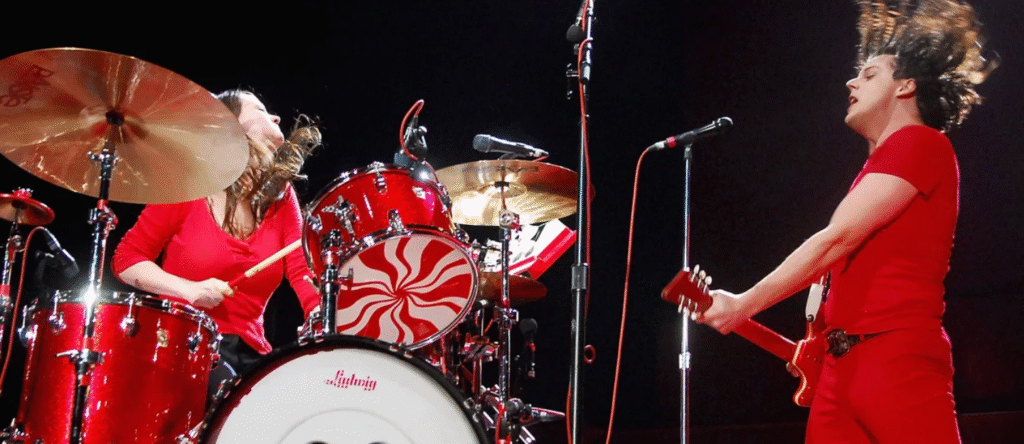
Visually, Meg White often seemed serene, stoic, almost statuesque. This contrasted beautifully with Jack’s kinetic intensity: She anchored the chaos. Their dynamic fed the band’s imaginative identity, which allowed them to stand out in an era crowded with larger-than-life personalities and dense studio productions. The format of the duo itself was part of the magic: just the two of them, one guitar, one drum kit.
The minimal arrangement forced creativity. It also made every choice more noticeable. Meg White played with a sense of presence because there was no room to hide, and paradoxically, that vulnerability became powerful. It felt like walking into a room where the floor creaks but holds, warm and worn in the best way.
The White Stripes and the Revival of Raw Rock
When The White Stripes emerged in the late 90s and early 2000s, popular rock was drifting into either glossy radio polish or heavier sonic landscapes. The White Stripes, with their stripped-down approach, landed like a lightning bolt. Their early records carried a garage-rock scruffiness that felt awake in a world getting sleepier.
The analog textures and rough edges weren’t nostalgic; they were liberation. Listeners could feel hands on strings, sticks on drums, breath on microphones. The imperfections were the point. Meg’s rhythmic sensibilities shaped this revival: a steady heartbeat that allowed the songs to retain their rawness while still making sense.
Without her grounding patterns, many of the band’s most iconic tracks could have toppled under their own intensity. Instead, she provided a structure that let the chaos dance without collapsing.
Cultural Impact: Beyond the Notes
Meg White’s impact isn’t only musical-it’s cultural, emotional, and symbolic. She challenged expectations without ever framing herself as a challenger.
1. Drumming Archetypes: Redefined
In a landscape saturated with technical virtuosity, Meg White showed the value of feel over flash. Her drumming spoke to people who didn’t see themselves reflected in the adrenalized world of rock percussion. She showed that intuition, instinct, and emotional clarity matter as much as-and sometimes more than-athletic technicality.
2. Inspiring a New Wave of Musicians
A whole generation of artists grew up watching The White Stripes push the boundaries of what a two-person band could do. Indie duos, minimal setups, and raw performances all owe them a great debt, specifically Meg’s contributions. She normalized the aesthetic shift toward authenticity and simplicity that still guides emerging acts.
3. Reclaiming the Power of Restraint
Meg’s work reminds audiences that music is not a competition. Her confidence in leaving space, in being deliberate rather than showy, offered refreshing counterbalance to trends that equate complexity with value. Her restraint became part of the band’s signature power.
Spotlight Moments: Songs that define Meg’s personality
While the entire catalog of The White Stripes carries Meg White’s fingerprints, certain tracks highlight her singular style.
- Seven Nation Army: The song that conquered the world starts with a beat that feels inevitable. Her drumming is the scaffolding that Jack’s iconic riff climbs; without her steady presence, the structure wouldn’t stand.
- Fell in Love with a Girl: Fast, punchy, and kinetic, this track showcases just how much energy Meg could create with minimalist textures.
- We’re Going to Be Friends: Here, her soft, tambourine-like percussion gives the song a lullaby glow. It’s a reminder that drumming isn’t always about loudness; sometimes it’s about gentleness.
- Blue Orchid: This crisp, mechanical beat propels the track with a sharp insistence, both primal and precise.
- Dead Leaves and the Dirty Ground: Her pacing lets the emotional weight of Jack’s lyrics hit harder. She doesn’t rush. She lets the song breathe.
Each of these songs carries Meg’s unmistakable fingerprint, understated yet indispensable.
The Legacy That Refuses to Fade
The White Stripes officially broke up in 2011, but their presence still resonates through playlists, arenas, film soundtracks, and bedroom speakers. And Meg White remains the object of fascination, appreciation, and at times debate-which is another kind of cultural longevity.
The discussion around her drumming has continued to evolve. Musicians and critics increasingly recognize a depth inside her simplicity. Those who spoke disparagingly of her style now speak of her with reverence. It is quite surprising how time can show what the hype often obscures.
She leaves behind a legacy of artistic courage. She played the way that felt right to her, even when it went against the grain of what others expected. That type of authenticity is never out of style.
Why Meg White Still Matters Today
Modern music often exists in a whir of technology and perfectionism: auto-corrected vocals, quantized drums, and layer upon layer of digital sheen. It’s in this environment that Meg White shines as a reminder that humanity in music is irreplaceable.
She is the compass toward presence, restraint, and instinct. Her influence whispers through artists that embrace imperfection as texture, not flaw. The White Stripes’ catalog continues to gather new listeners because it feels alive, unpolished, and deeply personal. At the core of that alive sound is Meg, tracing and shaping that experience with every deliberate hit.

Final Thoughts
Meg White’s contribution to music is one of quiet power. Her drumming served as both a foundation and an invitation, giving The White Stripes their unmistakable identity. She helped rekindle a fire in rock music that still burns today. Her legacy is less about volume and more about resonance.
Less about complexity and more about clarity. In a world abuzz with noise, Meg White is the reminder that sometimes the beauty of simple truths needs little more than unyielding rhythm. Her influence is not timeless, but rather alive.